
Follow the latest Medicare billing guidelines, coding requirements, and documentation standards to reduce claim denials and maximize reimbursements.
Medicare urgent care billing operates under the same framework as physician outpatient services, but with unique operational dynamics due to walk-in, episodic care. Most urgent care visits in the USA are billed using Evaluation & Management (E/M) codes, and reimbursement depends heavily on documentation of medical decision-making (MDM).
Because urgent care centers handle high patient volume with varying acuity, consistent coding protocols are essential. Misclassification of visit levels or missing documentation can quickly lead to underpayment or audit exposure.
| Component | Billing Element | Medicare Expectation | Revenue Impact |
|---|---|---|---|
| Visit Type | E/M Services | Based on MDM/time | Core revenue driver |
| Patient Status | New vs Established | Affects code range | Payment variation |
| Setting | Outpatient POS | POS 20 (Urgent Care) | Correct processing |
| Documentation | Clinical notes | Must support level | Prevents downcoding |
Urgent care centers differ from traditional practices because of unpredictable patient flow and limited patient history. This makes accurate documentation even more critical for Medicare claims of urgent care practices.
Additionally, urgent care providers in the USA must balance speed with compliance, coding errors made under pressure can lead to significant revenue leakage over time.
Need support with your billing workflow? Explore our medical billing and revenue cycle services or request a free consultation.
| Challenge | Operational Reality | Billing Risk | Strategic Approach |
|---|---|---|---|
| High Volume | Fast-paced visits | Coding errors | Standard templates |
| Limited History | Walk-in patients | Under-documentation | Focused notes |
| Mixed Acuity | Minor to moderate cases | Level confusion | MDM-based coding |
| Staffing Variation | Rotating providers | Inconsistent billing | Training protocols |
Urgent care billing relies heavily on E/M codes, which are selected based on medical decision-making complexity or total time spent. Choosing the correct level is for accurate reimbursement of your medical practices.
Overcoding can trigger audits, while undercoding leads to lost revenue, making proper level selection a key financial lever.
| CPT Code | Patient Type | MDM Level | Avg Medicare Payment |
|---|---|---|---|
| 99202 | New | Straightforward | $70–$90 |
| 99203 | New | Low | $90–$120 |
| 99204 | New | Moderate | $120–$180 |
| 99212 | Established | Straightforward | $50–$70 |
| 99213 | Established | Low | $70–$100 |
| 99214 | Established | Moderate | $100–$150 |
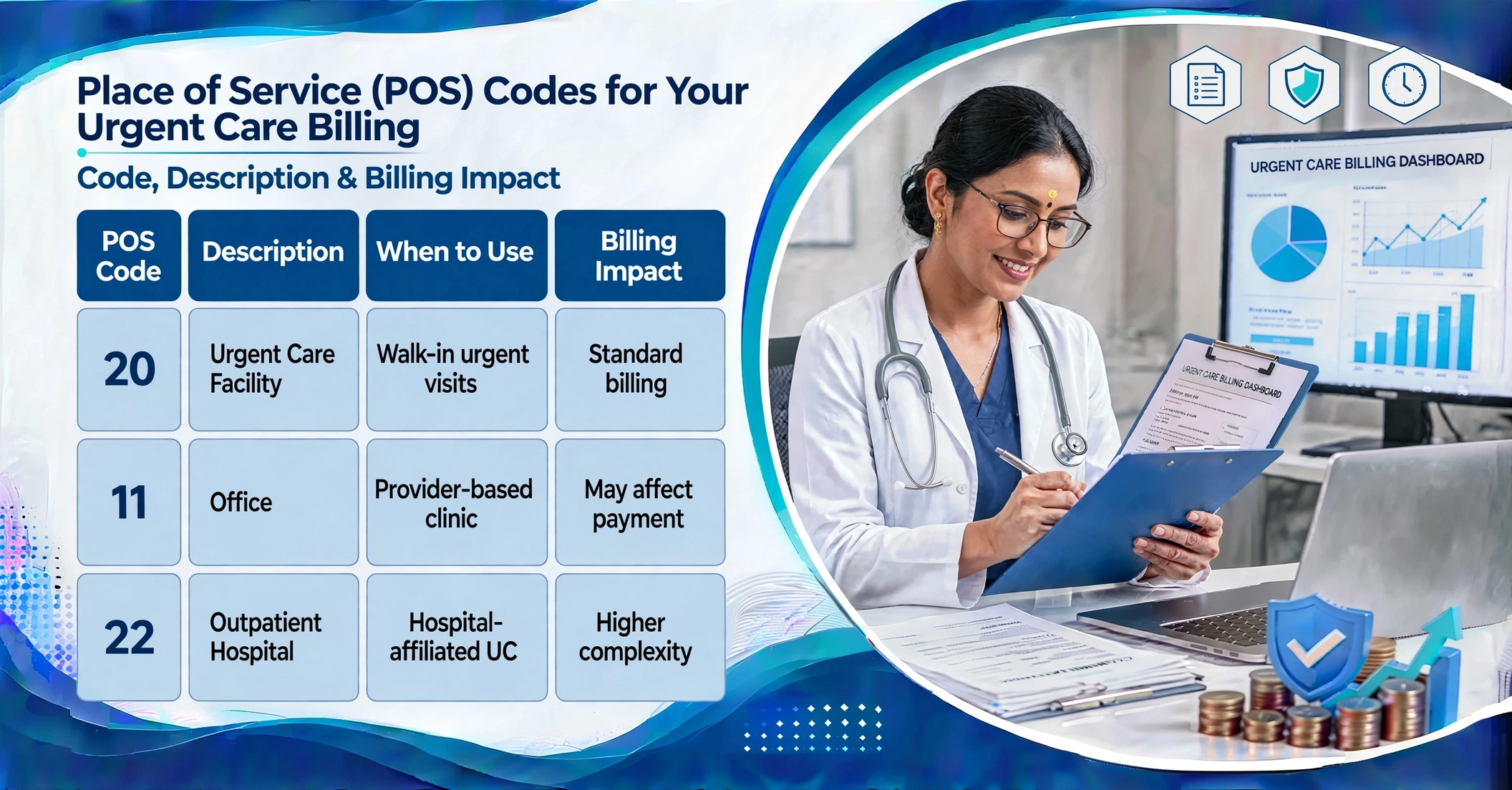
Correct POS coding ensures that Medicare processes the claim under the appropriate outpatient setting. Urgent care centers typically use POS 20, and incorrect POS coding can result in claim rejection or incorrect reimbursement rates.
| POS Code | Description | When to Use | Billing Impact |
|---|---|---|---|
| 20 | Urgent Care Facility | Walk-in urgent visits | Standard billing |
| 11 | Office | Provider-based clinic | May affect payment |
| 22 | Outpatient Hospital | Hospital-affiliated UC | Higher complexity |
Diagnosis coding in urgent care must reflect the patient’s presenting condition and justify the level of service billed. Accurate coding supports medical necessity.
Since urgent care treats a wide range of conditions, coding specificity is essential to avoid denials and ensure proper reimbursement.
| ICD-10 Code | Condition | Common Scenario | Billing Strength |
|---|---|---|---|
| J06.9 | Upper respiratory infection | Cold/flu symptoms | High |
| R07.9 | Chest pain | Acute complaint | High |
| S93.4 | Ankle sprain | Injury visit | High |
| Z20.822 | COVID exposure | Screening visit | Moderate |
Medicare differentiates between new and established patients based on whether the patient has received services from the provider within the past three years.
This classification directly affects which CPT codes can be used and the reimbursement amount.
| Type | Definition | Code Range | Payment Impact |
|---|---|---|---|
| New Patient | No visit in 3 years | 99202–99205 | Higher reimbursement |
| Established | Seen within 3 years | 99211–99215 | Lower reimbursement |
| Misclassification | Incorrect status | Claim error | Denial risk |
Documentation must clearly support the level of E/M service billed. Medicare emphasizes medical decision-making over volume of documentation. Incomplete or generic notes often lead to downcoding or denials.
| Element | Requirement | Purpose | Risk if Missing |
|---|---|---|---|
| Chief Complaint | Clearly stated | Justifies visit | Denial |
| MDM | Complexity documented | Supports CPT level | Downcoding |
| Assessment/Plan | Treatment details | Clinical validity | Audit risk |
| Time (if used) | Total minutes | Alternative coding | Rejection |
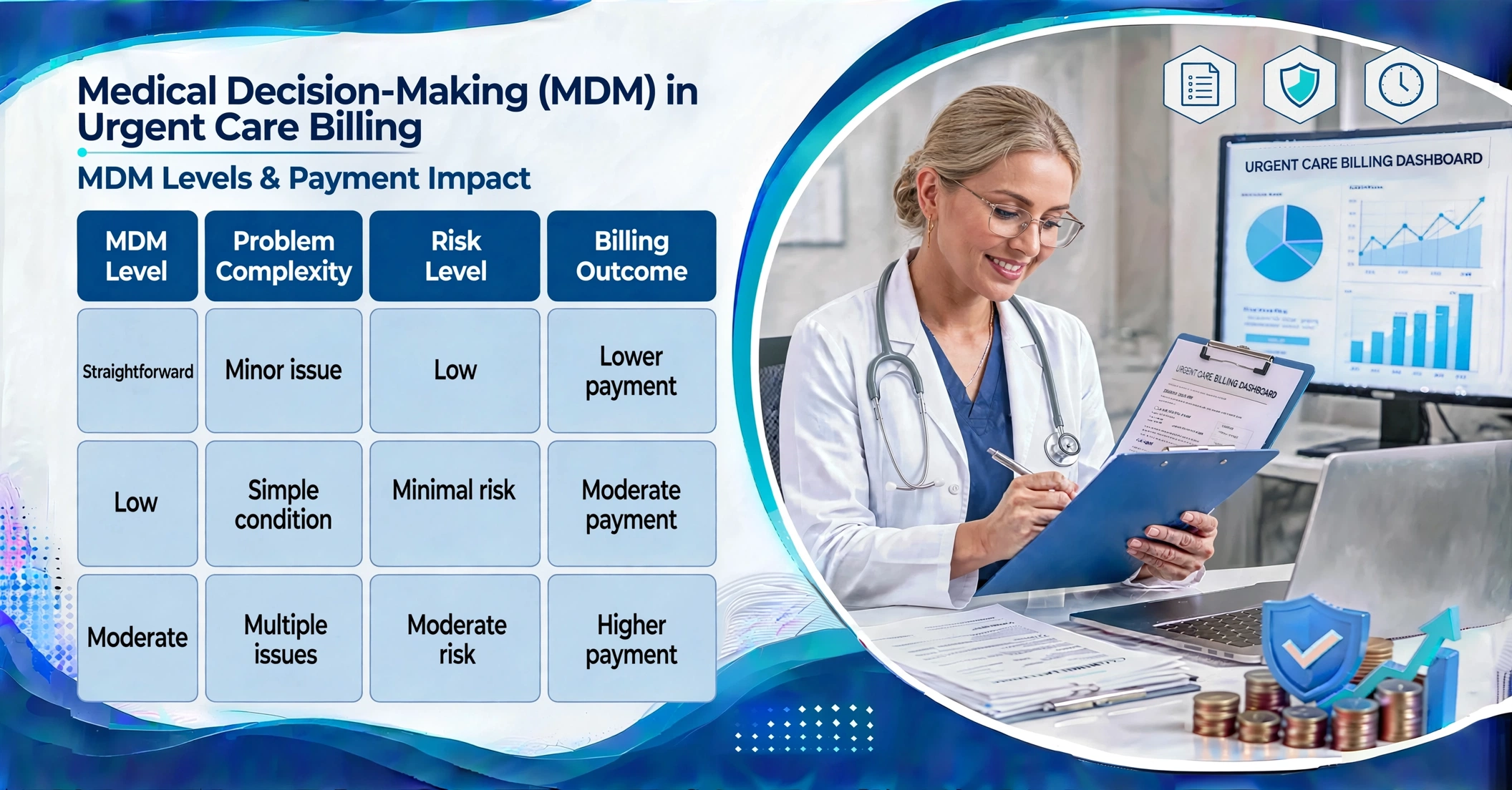
MDM is now the primary factor in selecting E/M levels. It includes problem complexity, data reviewed, and risk of complications. The urgent care providers must accurately reflect decision-making complexity to justify higher-level codes.
| MDM Level | Problem Complexity | Risk Level | Billing Outcome |
|---|---|---|---|
| Straightforward | Minor issue | Low | Lower payment |
| Low | Simple condition | Minimal risk | Moderate payment |
| Moderate | Multiple issues | Moderate risk | Higher payment |
Modifiers are essential when multiple services are performed during the same visit. They help prevent claim bundling and ensure full reimbursement, and incorrect or missing modifiers use by your team can lead to partial payments or denials.
| Modifier | Purpose | Use Case | Benefit |
|---|---|---|---|
| -25 | Separate E/M service | With procedures | Extra reimbursement |
| -59 | Distinct service | Multiple procedures | Avoid bundling |
| -76 | Repeat service | Same-day repeat | Accurate billing |
In addition to E/M services, urgent care centers frequently bill minor procedures. These must be coded separately and supported with documentation. Proper bundling rules must be followed to avoid compliance issues.
| Procedure | CPT Code | Scenario | Payment Range |
|---|---|---|---|
| Laceration Repair | 12001–12007 | Minor cuts | $80–$200 |
| X-ray | 71045 | Chest imaging | $30–$60 |
| Rapid Flu Test | 87804 | Flu diagnosis | $20–$40 |
Medicare covers medically necessary urgent care visits but does not cover routine or non-essential services, you need to completely understand coverage boundaries, that will help you to prevent denial claims and patient billing issues.
| Service Type | Covered | Condition | Billing Impact |
|---|---|---|---|
| Acute illness | Yes | Necessary care | Reimbursed |
| Preventive care | Limited | Specific cases | May deny |
| Routine exams | No | Non-urgent | Patient pays |
Due to the fast-paced environment, urgent care centers are prone to billing mistakes. These errors can significantly affect revenue. Identifying and correcting them improves claim success rates.
| Error | Cause | Impact | Fix |
|---|---|---|---|
| Wrong E/M level | Poor MDM | Under/overpayment | Train staff |
| Missing modifier | Oversight | Bundled payment | Add modifier |
| Incorrect POS | Setup error | Claim denial | Verify POS |
Denial management is a critical part of the revenue cycle. Most denials are due to documentation or coding issues, and a structured approach helps you to recover payments efficiently.
| Step | Action | Outcome | Tip |
|---|---|---|---|
| Analyze | Review denial | Identify issue | Check codes |
| Correct | Fix errors | Clean claim | Update docs |
| Resubmit | Send claim | Recover payment | Track status |
Maximizing revenue in urgent care requires a balance between speed and accuracy. Your small improvements in coding accuracy can significantly increase your practice revenue, so as a provider you should focus on correct E/M leveling and timely submissions.
| Strategy | Action | Benefit | Result |
|---|---|---|---|
| Accurate Coding | Correct CPT | Higher payment | Less denial |
| Eligibility Check | Verify coverage | Fewer rejections | Faster cash |
| Timely Filing | Submit quickly | Avoid delays | Better flow |
Medicare is increasing scrutiny on outpatient and urgent care billing. High-volume practices are especially at risk in all states of the USA, you need to maintain compliance to avoid losses.
| Risk Area | Audit Focus | Impact | Prevention |
|---|---|---|---|
| E/M Levels | Overcoding | Penalties | Accurate MDM |
| Documentation | Insufficient notes | Denials | Detailed records |
| Modifier Use | Misuse | Recoupment | Proper training |
Urgent care billing is evolving with changes in telehealth, value-based care, and CMS regulations. Providers must stay adaptable. Technology and automation will play a key role in improving billing accuracy and efficiency.
| Trend | Change | Impact | Opportunity |
|---|---|---|---|
| Telehealth | Expanded use | New billing models | More access |
| Automation | AI coding | Fewer errors | Efficiency |
| Value-Based Care | Outcome focus | Payment shifts | Quality care |
From patient registration through final payment, we simplify the billing process so your staff can work more efficiently and your clinic can grow with confidence.
Get a free assessment from our billing experts