
Proper use of CPT, HCPCS, and ICD-10 codes, along with complete documentation, is essential for successful Medicare claim submission. Applying current billing guidelines improves payment accuracy and helps maintain regulatory compliance.

Accurate Medicare physician assistant billing is essential for protecting revenue and ensuring every covered service is reimbursed correctly. According to our experience, your proper CPT, ICD-10-CM, and HCPCS coding, along with complete documentation, helps you reduce claim denials, payment delays, and costly billing errors that can impact a practice’s financial performance in 2026.
As Medicare policies continue to evolve, as a physician assistant you must stay aligned with the latest billing, supervision, and documentation requirements. Following current Medicare guidelines improves first-pass claim acceptance, strengthens compliance, minimizes audit risks, and maximizes reimbursement while supporting a more efficient revenue cycle.
Need support with your billing workflow? Explore our medical billing and revenue cycle services or request a free consultation.
By default, Medicare reimburses services billed under a physician assistant at 85% of the physician fee schedule. That means if your workflow isn’t optimized, you’re automatically leaving 15% on the table for many services.
The issue isn’t that 85% is wrong, it’s that many practices fail to identify when 100% reimbursement is legitimately possible (like incident-to or split/shared services).
Solution:
As a practice owner you need to build a billing strategy, not just a process. Identify when services qualify for:
Split/shared billing has become a major focus in recent CMS updates. In facility settings (like hospitals), services can be billed under the physician at 100%, but only if documentation clearly supports who performed the substantive portion.
Many practices:
This creates both audit risk and lost revenue opportunities.
Solution:
You need to clearly document:
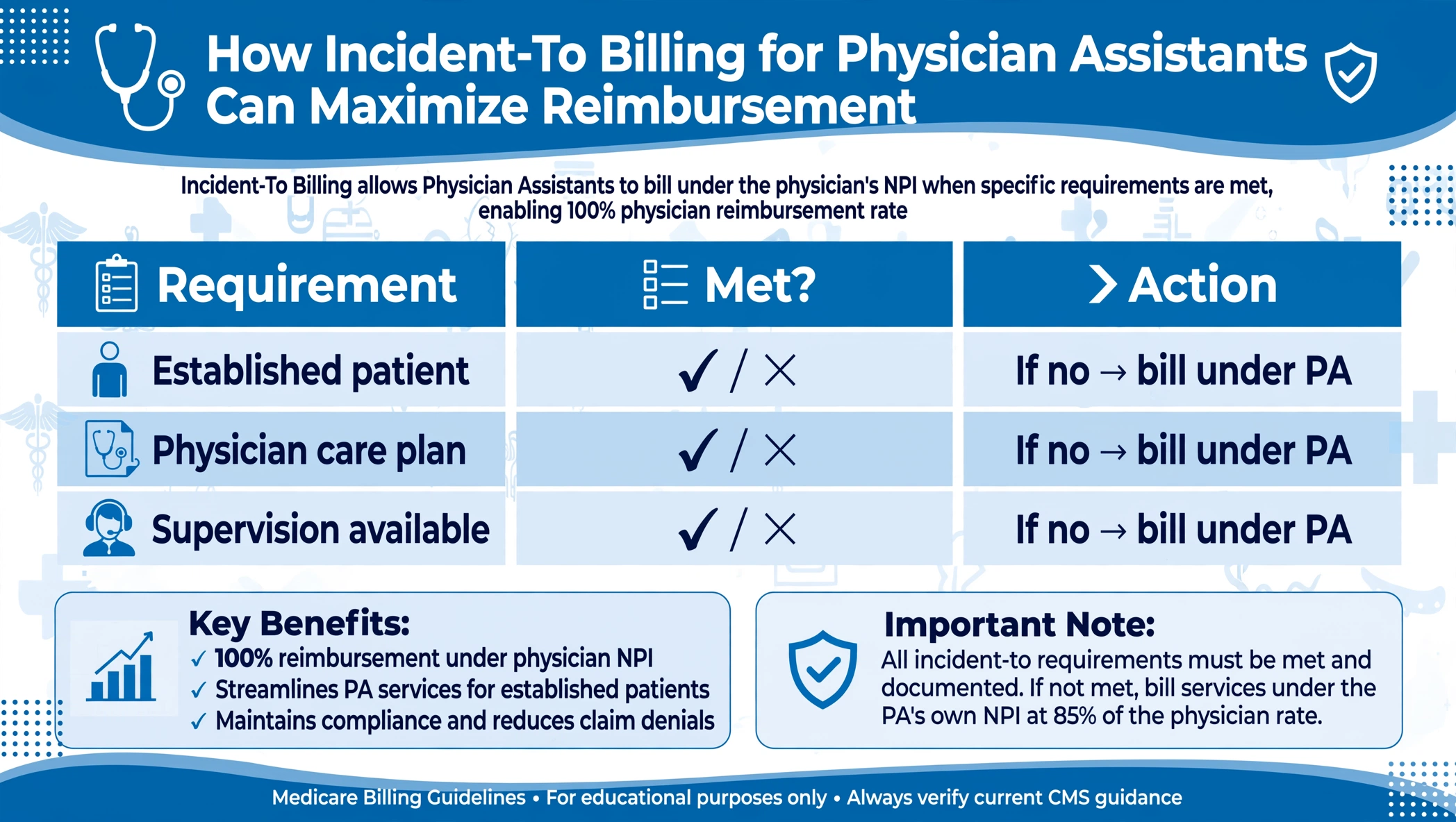
Incident-to billing is one of the most powerful tools in outpatient settings, but also one of the most misused.
To bill at 100%, Medicare requires:
If any condition is missing, the claim becomes non-compliant—even if paid initially.
Solution:
Use incident-to selectively and safely. Create a checklist-based workflow:
| Requirement | Met? | Action |
|---|---|---|
| Established patient | ✔/✘ | If no → bill under PA |
| Physician care plan | ✔/✘ | If no → bill under PA |
| Supervision available | ✔/✘ | If no → bill under PA |
Documentation is the backbone of PA billing compliance. Medicare is increasingly focused on:
Inconsistent or unclear notes can raise red flags, especially when billing under a physician.
Solution:
It is important for your practice that you note should clearly answer:
Solution:
As an experienced physician you need to separate and validate both components clearly. Reconcile treatment logs with billing daily.
Many practices overlook enrollment details, but incorrect use of NPIs can lead to:
For example:
Solution:
You need to regularly audit your provider enrollment data. Ensure:
CMS continues to expand flexibility for non-physician practitioners, including:
However, with flexibility comes complexity. Practices that don’t stay updated risk falling behind, or becoming non-compliant.
Solution:
Stay informed and adaptive. Billing teams should:
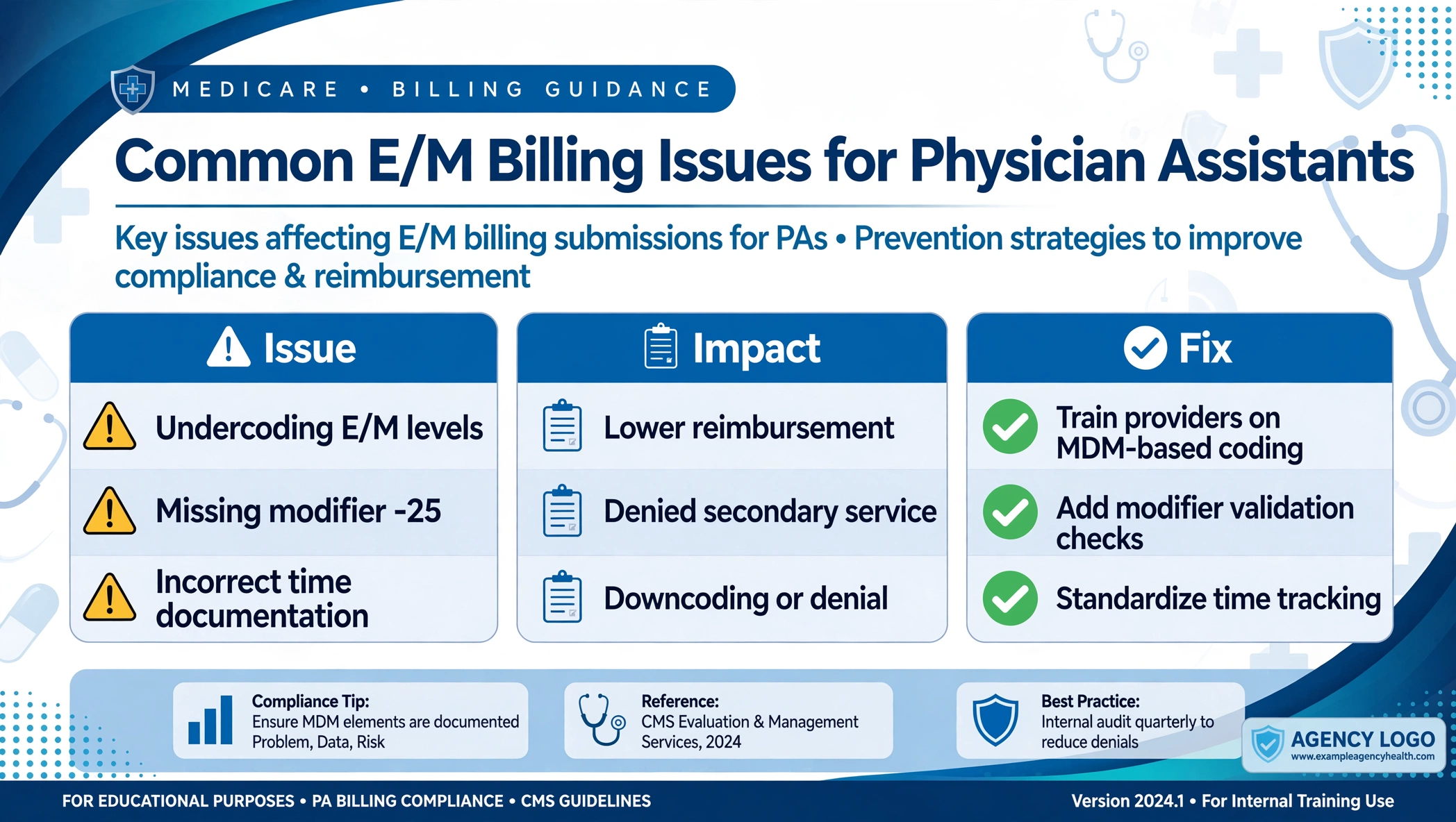
E/M coding has changed significantly, focusing more on MDM and time. Many practices still:
This results in consistent underpayment.
| Issue | Impact | Fix |
|---|---|---|
| Undercoding E/M levels | Lower reimbursement | Train providers on MDM-based coding |
| Missing modifier -25 | Denied secondary service | Add modifier validation checks |
| Incorrect time documentation | Downcoding or denial | Standardize time tracking |
Solution:
Align providers and coders on E/M rules. Even small improvements here can significantly boost revenue.
Denials are rising due to:
Many practices only react after denials happen, which increases AR days and reduces collections.
Solution:
For your practice success you need to create a denial-resistant workflow:
Manual workflows, disconnected systems, and lack of automation can slow down the entire revenue cycle.
This leads to:
Solution:
If you want that your practice will be successful you need to streamline your workflow with:
Managing PA billing in-house is becoming more difficult due to:
Outsourcing gives you access to specialists who understand:
Solution:
Outsourcing can:
Many practices focus on fixing errors but ignore strategy. The real issue isn’t just mistakes, it’s missed opportunities.
Without a strategy, practices:
Solution:
Think strategically:
Audits are no longer optional—they’re essential. They help identify:
Solution:
Run quarterly audits focusing on:
Our customized billing strategies help your practice strengthen cash flow, increase collections, and support sustainable business growth.
Get a free assessment from our billing experts