


The Ultimate Neonatal Billing Services Guide for US Physicians and Medical Practices
Our Neonatal Medical Billing services help practices manage complex newborn care billing, specialty-specific coding, documentation standards, and payer requirements. We optimize claims, reduce denials, and improve reimbursements through efficient revenue cycle management.

Neonatology Billing Services: The Complete Guide for US Healthcare Professionals (2025)
Walk into any Neonatal Intensive Care Unit (NICU), and you immediately feel the weight of it, monitors beeping softly, nurses moving with quiet urgency, and parents holding their breath beside incubators. Every decision matters. Every intervention is critical. And somewhere behind that deeply human reality, there’s another world working just as hard: documentation, coding, claims, and reimbursements.
That’s exactly why neonatology billing services are not just administrative functions. When executed correctly, they become the financial backbone that keeps your neonatal practice stable, compliant, and profitable.
Related Billing and Revenue Cycle Guides
- TRICARE Claims Billing Guidelines for Providers 2026
- TRICARE South Billing Guidelines for Providers 2026
Need support with your billing workflow? Explore our medical billing and revenue cycle services or request a free consultation.

Table of Contents
- What Is Neonatology Medical Billing — and Why Does It Matter?
- Key CPT Codes Used in Neonatology Billing Services
- ICD-10 Diagnosis Codes Every Neonatology Biller Must Know
- Neonatal Critical Care Billing: Weight-Based and Day-Based Rules
- NICU Billing Documentation: What Payers Actually Want to See
- Common Neonatology Billing Errors That Drain Your Revenue
- How Medicare and Medicaid Handle Neonatology Billing
- Neonatology Billing Services for Prolonged NICU Stays
- Coding Specialized NICU Procedures: A Practical Reference Table
- Denial Management in Neonatology Medical Billing Services
- Prior Authorization and Eligibility Verification in NICU Billing
- Tips for Compliance: Audit-Proofing Your Neonatology Billing Services
- Why Outsourcing Neonatology Billing Services Makes Financial Sense
- How Technology Is Changing Neonatology Billing and Coding
- How House of Outsourcing Supports Your Neonatology Billing Services
- Frequently Asked Questions About Neonatal Billing
What is Neonatology Medical Billing and Why Does It Matter?
Neonatology medical billing is the specialized process of coding, submitting, and managing claims for healthcare services provided to newborns, particularly those in the NICU requiring critical or intensive care. It’s arguably one of the most complex areas of medical billing in the United States, here’s why it’s so uniquely challenging:
- Your practice patients are measured in grams, and their birth weight directly determines billing codes.
- Conditions change daily, sometimes hourly, requiring updated documentation and codes
- NICU stays can last weeks or months, generating hundreds of billable interactions
- Payer rules for neonatal care vary significantly between Medicare, Medicaid, and commercial insurers
- The average NICU stay in the U.S. exceeds $76,000, with complex cases reaching $500,000 or more. According to CMS guidelines for neonatal critical care, services must be precisely documented and coded to reflect the acuity of care provided.
Key CPT Codes Used in Neonatology Billing Services
If there’s one area where neonatology medical billing diverges most sharply from general pediatric billing, it’s in the CPT code structure. These codes are weight-based and day-based, which means your clinical documentation must capture both with precision.
Neonatal Intensive Care CPT Codes (Weight-Based)
| CPT Code | Description | Weight Category |
|---|---|---|
| 99468 | Initial inpatient neonatal critical care | Per day, ≤ 28 days, requires critical care |
| 99469 | Subsequent neonatal critical care | Per day, ≤ 28 days |
| 99471 | Initial intensive care, per day | Birth weight 1,500–2,500g |
| 99472 | Subsequent intensive care | Birth weight 1,500–2,500g |
| 99475 | Initial intensive care, per day | Birth weight > 2,500g |
| 99476 | Subsequent intensive care | Birth weight > 2,500g |
| 99460 | Initial care, normal newborn | ≤ 28 days, not requiring critical care |
| 99461 | Initial care, normal newborn | Other than hospital/birthing center |
| 99462 | Subsequent normal newborn care | Per day |
| 99463 | Initial and discharge newborn care | Same day |
| 99464 | Attendance at delivery | Stabilization of newborn |
| 99465 | Delivery/birthing room resuscitation | Newborn requiring resuscitation |
ICD-10 Diagnosis Codes Every Neonatal Biller Must Know
Accurate ICD-10 coding is just as critical as CPT code selection in neonatal medical billing. The diagnosis codes must reflect the infant’s specific condition, and they often evolve across the NICU stay as conditions improve, worsen, or are newly identified.
Most Commonly Used ICD-10 Codes in NICU Billing
| ICD-10 Code | Description |
|---|---|
| P07.00–P07.39 | Disorders of prematurity and low birth weight |
| P22.0 | Respiratory distress syndrome of newborn |
| P27.1 | Bronchopulmonary dysplasia / chronic lung disease |
| P59.0–P59.9 | Neonatal jaundice (various types) |
| P36.x | Bacterial sepsis of newborn |
| R68.82 | Neonatal sepsis (unspecified) |
| P52.x | Intracranial hemorrhage (newborn) |
| Q21.3 | Congenital heart defect — Tetralogy of Fallot |
| P29.3 | Patent ductus arteriosus |
| P77.x | Necrotizing enterocolitis (NEC) |
| P35.0 | Congenital rubella syndrome |
| P70.4 | Transient neonatal hypoglycemia |
| Z38.00–Z38.8 | Newborn birth status (singleton, multiple, etc.) |
Neonatal Critical Care Billing: Weight-Based and Day-Based Rules
One of the most misunderstood aspects of neonatology billing services is the interaction between birth weight and day of care when selecting the correct CPT code. Let’s break it down clearly.
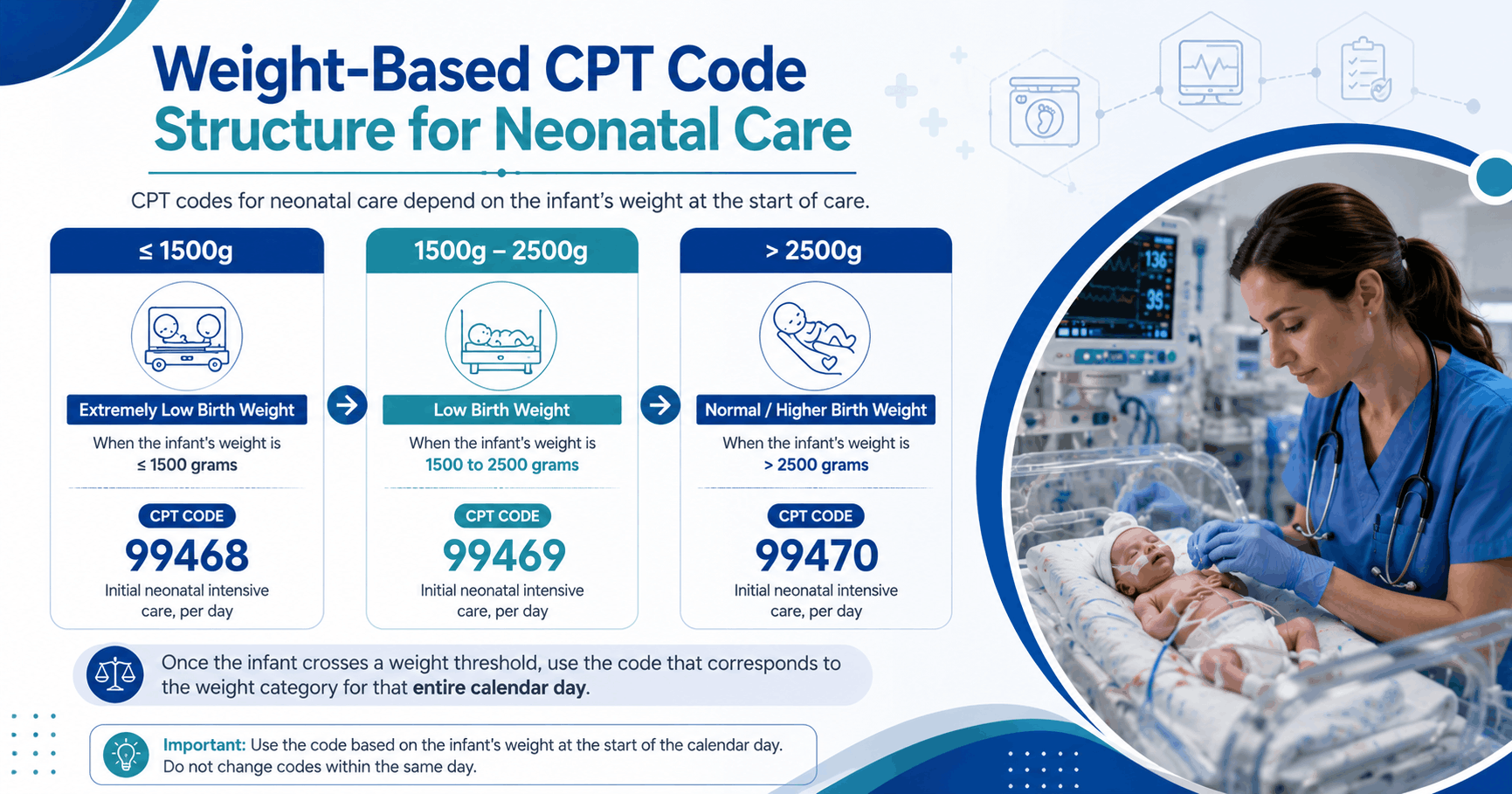
The Weight-Transition Rule
When a newborn’s weight changes (which happens naturally as premature infants gain weight during the NICU stay), the CPT code category must be updated to reflect that change. This is known as the weight-transition rule, and it’s a frequent source of coding errors.
For example:
- An infant admitted weighing 1,200g would initially be coded under 99468 (critical care)
- Once stable and transitioned to intensive care, that same infant now codes under 99471 (1,500–2,500g) if weight has increased
- Once the infant surpasses 2,500g, billing shifts to 99475
NICU Billing Documentation: What Payers Actually Want to See
Great documentation is the foundation of successful neonatology medical billing services. Without it, even the most experienced coder can’t protect your revenue. Here’s what commercial payers, Medicare, and Medicaid consistently require:
Non-Negotiable Documentation Elements
For Critical Care (99468/99469):
- Total physician time spent in critical care activities
- Direct face-to-face bedside time
- Medical decision-making complexity
- Specific interventions and their clinical necessity
For Intensive Care (99471–99476):
- Birth weight (current and at birth)
- Gestational age at birth
- Day of life
- Device dependency (ventilator, CPAP, umbilical catheter)
- Specific diagnoses supported by clinical findings
For Procedures:
- Start and stop times for time-based services
- Specific technique and approach used
- Clinical indication for each procedure
- Response to treatment documented in follow-up
Documentation Red Flags That Invite Audits
- Copy-pasting daily notes without updating clinical details
- Missing transition-of-care documentation (NICU to step-down, step-down to general pediatrics)
- Lack of time documentation for transport or prolonged service codes
- Notes that read “stable, continue current management” without specific clinical data
- Missing parent counseling documentation when billing 99497/99498
Common Neonatology Billing Errors That Drain Your Practice Revenue
In our experience working with neonatal practices across the United States, certain billing errors come up again and again. Each one quietly erodes revenue, often without providers even realizing it.
Top 7 Neonatology Medical Billing Mistakes
Upcoding or Downcoding Critical Care vs. Intensive Care: Selecting 99468 when the infant doesn’t meet critical care criteria (or using 99475 when the infant clearly does) creates both compliance risk and revenue loss.
Incorrect Birth Weight Documentation: Using estimated or rounded birth weights instead of the actual documented birth weight in grams.
Missing Transition Coding: When an infant transfers from NICU to a step-down unit or general pediatrics, billing must reflect the correct level of care. Continuing to bill critical care codes post-transition is a top audit trigger.
Bundling Errors for Separately Billable Procedures: Many NICU procedures, like central line placement, ventilator management, and surfactant administration are separately billable but frequently bundled incorrectly.
How Medicare and Medicaid Handle Neonatology Billing
It is important for your medical practice growth that you have complete understanding payer-specific rules are non-negotiable in effective neonatology billing. Medicare and Medicaid each have their own requirements, and getting them wrong means denials.
Medicare and Neonatology Billing
Medicare primarily covers newborns when they are enrolled as beneficiaries in their own right, which is rare for routine neonatal care. However, Medicare Part A covers hospital inpatient services for newborns when the mother is a Medicare beneficiary under specific circumstances.
Medicaid and Neonatology Billing
Medicaid is the dominant payer for NICU care in the United States. According to March of Dimes data, approximately 43% of all NICU admissions are covered by Medicaid. Each state administers its own Medicaid program, which means:
- Reimbursement rates vary significantly by state
- Prior authorization requirements differ
- Some states use DRG (Diagnosis-Related Group) bundled payment models for NICU care
- Managed Medicaid (MCO) plans may have additional documentation requirements
Neonatology Billing Services for Prolonged NICU Stays
Prolonged NICU admissions lasting weeks or months create unique billing challenges. The documentation volume is enormous, the complexity escalates over time, and the billing requirements evolve as the infant’s condition changes.
Key Strategies for Prolonged-Stay Billing
Daily Documentation Discipline: Each day in your NICU requires a new, distinct clinical note that captures the infant’s current status. Copy-forward notes are a major compliance risk. Each entry should document:
- Current birth weight and gestational age equivalent
- Active diagnoses and their current status
- Interventions performed on that specific day
- Medical decision-making rationale
Tracking Level-of-Care Transitions: Over a prolonged NICU stay, an infant may transition between critical care, intensive care, and intermediate/step-down care multiple times. Each transition requires a billing level change and distinct documentation to support it.
Coding Evolving Diagnoses: As the NICU stay progresses, primary diagnoses evolve. For example, P22.0 (Respiratory Distress Syndrome) may transition to P27.1 (Bronchopulmonary Dysplasia) as the condition becomes chronic. These updates must be reflected in the coding to match clinical reality.
Coding Specialized NICU Procedures: A Practical Reference Table
NICU patients frequently undergo highly specialized procedures. Accurate coding for these services is critical to capturing the full scope of care provided. Below is a reference guide for the most common NICU procedures and their corresponding CPT codes.
NICU Procedures CPT Code Reference
| Procedure | CPT Code(s) | Key Billing Consideration |
|---|---|---|
| Ventilator Management (invasive) | 94002–94003 | Bill daily; separate from critical care code |
| Ventilator Management (non-invasive) | 94004–94005 | CPAP/BiPAP for NICU patients |
| Central Line Placement (PICC) | 36568–36571 | Requires fluoroscopy documentation if used |
| Umbilical Vein Catheterization | 36510 | Separate from NICU critical care codes |
| Exchange Transfusion | 36450 | For hemolytic disease or severe jaundice |
| ECMO — Initiation | 33946–33947 | Veno-arterial vs. veno-venous — code differs |
| ECMO — Daily Management | 33948–33949 | Per-day codes; separate from physician care codes |
| Surfactant Administration | 94610 | Instillation of surfactant via endotracheal tube |
| ROP Laser Treatment | 67031 | Retinopathy of prematurity |
| PDA Ligation | 33619 | Surgical closure of patent ductus arteriosus |
| NEC Surgery (laparotomy) | 44180 | Necrotizing enterocolitis surgical intervention |
| Lumbar Puncture | 62270 | Diagnostic; requires separate documentation |
| Intubation (endotracheal) | 31500 | Emergency intubation only; not routine |
| Myelomeningocele Repair | 63700 | Complex neurosurgery in neonates |
| Dialysis Access Placement | 36556 | For neonates requiring renal replacement therapy |
Denial Management in Neonatology Medical Billing
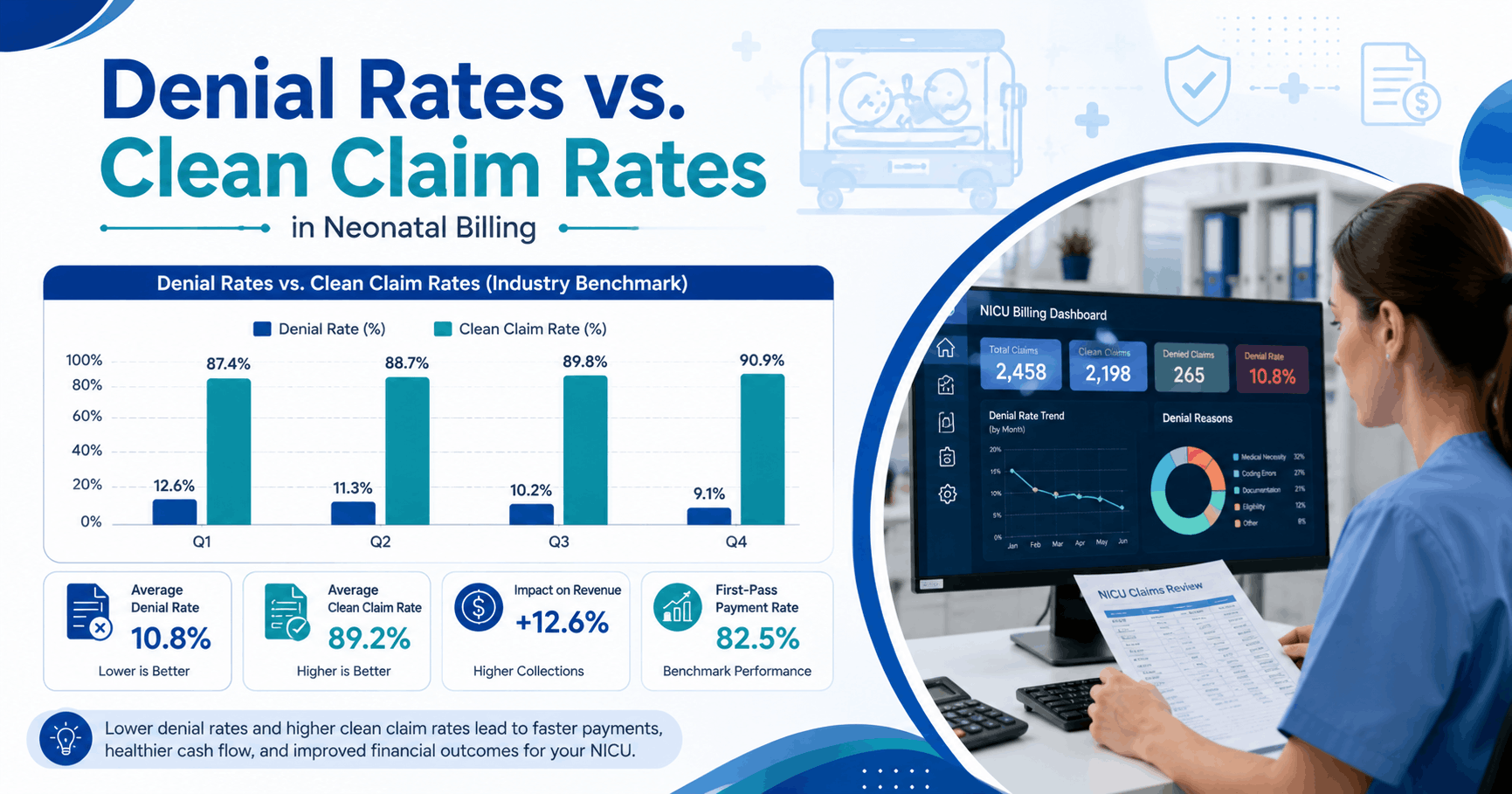
As an experienced physician you know that denials are the single biggest threat to revenue integrity in neonatology billing. In NICU billing, where claim values are high and codes are complex, a proactive denial management strategy is not optional, it’s the difference between financial health and financial crisis.
CMS assigns a Status Indicator to every HCPCS/CPT code under OPPS that tells the hospital billing system how the service is paid. The most important status indicators:
The Most Common Denial Reasons in Neonatology Billing
| Denial Type | Root Cause | Prevention Strategy |
|---|---|---|
| Medical Necessity | Insufficient documentation of critical care criteria | Build structured daily note templates |
| Wrong Payer Billed | Maternal vs. baby's insurance confusion | Verify baby's independent enrollment at admission |
| Authorization Missing | Prior auth not obtained for NICU admission | Real-time auth verification at point of admission |
| Bundling Violation | Separately billable procedure coded within critical care | Use NCCI edits to verify unbundling eligibility |
| Duplicate Claim | Multiple providers billing same service | Clear team billing protocols for NNPs, residents, attendings |
| Weight-Transition Error | Code not updated as infant gains weight | Weekly audit of weight-based code assignments |
| Timely Filing | Claim submitted outside payer window | Automated claim submission and tracking workflows |
Prior Authorization and Eligibility Verification in NICU Billing of Your Practice
In the NICU world, prior authorization and eligibility verification are often the weakest links in the revenue cycle, and they create some of the most painful, preventable denials across the USA.
Eligibility Verification Challenges Unique to Neonatology
The Newborn Enrollment Problem: Newborns are often not immediately enrolled in insurance under their own name. Many practices bill under the mother’s policy initially, which is appropriate in some cases but creates confusion and denials if not handled correctly by your medical billing team.
Per CMS guidelines, most insurance policies allow a 30-day window for newborn enrollment. After that, the newborn must be separately listed as a covered dependent.
Medicaid Presumptive Eligibility: Many states have Medicaid presumptive eligibility programs specifically for newborns. Understanding your state’s rules through Medicaid.gov can save billing teams significant time on authorization for high-risk admissions.
Prior Authorization Best Practices for NICU Billing
- Initiate authorization within 24 hours of NICU admission, don’t wait for the clinical picture to fully develop.
- You need to obtain a specific authorization number for each payer; managed care organizations often require separate authorizations for different service categories.
- It is your responsibility to update authorizations for extended stays, most payers issue authorizations in defined increments and require renewal.
- Document every authorization interaction (date, time, rep name, authorization number)
- For procedures like ECMO, PDA ligation, or neurosurgery, obtain procedure-specific authorizations in addition to the general admission authorization
Tips for Compliance: Audit-Proofing Your Neonatology Billing
Compliance in neonatology billing services is not just about avoiding fraud, it’s about building systems that protect your practice when payers or regulators take a closer look.
Your 2025 NICU Billing Compliance Checklist
Documentation Standards
- It is your billing team responsibility that your every daily NICU note must stand alone as a complete clinical record.
- As a provider you need proper attestation for resident or NNP notes must be substantive, not just a signature.
- Time documentation must be specific (e.g., “45 minutes of critical care activities from 2:15 PM to 3:00 PM”)
Coding Accuracy
- Conduct quarterly internal coding audits using CMS National Correct Coding Initiative (NCCI) guidelines.
- Use Medically Unlikely Edit (MUE) tables to verify procedure frequency limits
- Stay current with annual CPT code updates from the American Medical Association (AMA)
Training and Education
- Annual coding education for all providers billing neonatal services.
- Specific training on weight-transition rules and level-of-care transitions.
- Regular review of OIG Work Plan items related to neonatal billing (OIG Work Plan)
Why Outsourcing Neonatology Billing Services Makes Financial Sense For Your Medical Practice
More and more neonatal practices and pediatric hospital groups are making the decision to partner with specialized medical billing companies for their NICU billing. Here’s why that makes sense, both financially and operationally.
The Real Cost of In-House Neonatology Billing
Managing neonatology billing in-house requires specialized knowledge that is genuinely rare. Most general medical billers are not equipped to handle the complexities of weight-based coding, NICU-level documentation, or ECMO billing. The result? Frequent errors, preventable denials, and revenue leakage that compounds quietly over time.
What We As a Specialized Outsourced Partner Provides
| Benefit | Impact on Practice |
|---|---|
| Neonatal-trained coders | Fewer errors, higher first-pass clean claim rate |
| Proactive denial management | Up to 90% reduction in preventable denials |
| Authorization management | Fewer revenue delays from auth gaps |
| Real-time reporting | Practice leadership has visibility into revenue cycle health |
| Regulatory compliance | Up to-date on Medicare, Medicaid, and CMS rule changes |
| Reduced administrative burden | Clinicians focus on care, not paperwork |
| Scalability | Staff capacity grows with patient volume without overhead |
| Dedicated NICU billing focus | No competing priorities or diluted expertise |
How Technology is Changing Your Practice Neonatology Billing and Coding
The landscape of neonatology medical billing is evolving rapidly, driven by advances in EHR technology, AI-assisted coding, and data analytics.
Key Technology Trends in Neonatology Billing Services
AI-Assisted Coding: Artificial intelligence tools are increasingly being deployed to review your NICU documentation and suggest accurate CPT and ICD-10 codes. These tools can flag potential errors before claims are submitted, significantly improving first-pass acceptance rates.
EHR Integration: Modern NICUs are moving toward deeply integrated EHR platforms that connect clinical documentation directly to billing workflows. This reduces the transcription errors that occur when clinical notes are manually converted to billing data.
Predictive Analytics for Denial Prevention: Advanced RCM platforms can now analyze claim data in real time and predict which claims are at high risk of denial based on payer behavior patterns, documentation patterns, and code combinations.
How House of Outsourcing Supports Your Neonatology Billing
At House of Outsourcing, our certified billing specialists completely understand that neonatal billing is unlike any other specialty. The patients are the most vulnerable in medicine. The claims are among the most complex in healthcare. And the financial stakes, for both the practice and the families, are enormous.
That’s why our neonatology billing services are built around a simple philosophy: every claim we submit should reflect the full value of the care your team provides. Nothing more, nothing less.
What We Offer to Your Neonatal Practice and NICU Teams in the USA
Specialized Neonatal Coders: Our coding team is trained specifically in NICU billing, weight-based codes, weight-transition rules, ECMO, NICU procedures, and complex ICD-10 coding for neonatal conditions. We don’t assign generalist coders to specialty work.
End-to-End Revenue Cycle Management: From eligibility verification and prior authorization through claim submission, denial management, and patient billing, we handle the complete revenue cycle for your neonatal practice.
Compliance-First Approach: We stay current with CMS, Medicare, and Medicaid guidelines so you don’t have to. Every claim we submit is checked against the latest NCCI edits, MUE tables, and payer-specific policies.
Transparent Reporting: You’ll always know where your revenue stands. Our practice performance dashboards give you real-time visibility into clean claim rates, denial rates, days in A/R, and revenue trends.
Dedicated Account Management: You’ll have a dedicated account manager who understands your practice, your payer mix, and your specific billing challenges, not a rotating help desk.
Frequently Asked Questions About Neonatal Billing
What is the difference between neonatal critical care and neonatal intensive care billing?
Critical care (99468/99469) is billed when the infant requires critical care services as defined by CMS conditions that are life-threatening and require complex medical decisions. Intensive care (99471–99476) is billed when the infant requires ongoing monitoring and intervention but no longer meets the critical care threshold. The distinction is clinical, not just a matter of which unit the infant is in.
Can an NNP or PA bill for neonatal critical care services?
Nurse Practitioners (NNPs) and Physician Assistants can bill for neonatal services under their own NPI, but the specific billing rules, including whether they can bill critical care codes independently, depend on state scope of practice laws and payer policies. Medicare generally requires physician supervision for critical care services. Consult your CMS MAC (Medicare Administrative Contractor) for jurisdiction-specific guidance.
How does Medicaid reimburse NICU care differently from Medicare?
Each state Medicaid program sets its own NICU reimbursement rates, which vary widely. Some states use a DRG model for inpatient NICU stays; others use fee-for-service rates based on CPT codes.
What are the most common CPT codes used in everyday NICU billing?
The most frequently used codes in NICU billing are 99468 (initial neonatal critical care), 99469 (subsequent critical care), 99471/99472 (intensive care for 1,500–2,500g), and 99475/99476 (intensive care for >2,500g). Supplemental codes for ventilator management, central line procedures, and specialized interventions are added as applicable.
When should your neonatology practices consider outsourcing their billing?
If your practice is experiencing denial rates above 5%, days in A/R above 35, a first-pass clean claim rate below 95%, or staffing challenges maintaining in-house billing expertise should seriously evaluate outsourcing to a specialized neonatology billing services partner.
Medical Billing Services @ 2.45% of Total Collection
Get a free assessment from our billing experts